
G42 Microsoft Partnership: Inside the $15.2B AI Alliance
On this page +
What Is G42?
G42 is Abu Dhabi's flagship AI holding group: chaired by Sheikh Tahnoon bin Zayed Al Nahyan, the UAE's national security adviser, and run by Group CEO Peng Xiao, according to G42's corporate disclosures. It sits at the center of nearly every major UAE AI initiative covered in our complete guide to AI in the UAE.
Key Takeaways
- Microsoft's total UAE investment reaches $15.2 billion across 2023-2029, and that figure includes the $1.5 billion G42 equity stake announced in April 2024 (Microsoft, November 2025).
- Roughly $7.3 billion was spent between 2023 and 2025; another $7.9 billion or more is planned through 2029.
- The April 2024 deal came with a first-of-its-kind Intergovernmental Assurance Agreement between Washington and Abu Dhabi on AI safety and security.
- Microsoft holds US export licenses covering the equivalent of roughly 81,900 NVIDIA A100 GPUs for the UAE, granted in two tranches under two administrations.
- G42 divested its Chinese holdings in February 2024 and committed to phasing out Chinese hardware such as Huawei equipment.
Calling G42 a company undersells it. It is closer to a portfolio of national capabilities, organized as operating companies. Core42 runs sovereign cloud services. Inception builds AI models. Presight, which is publicly listed, handles big-data analytics. Khazna Data Centers builds and operates the physical infrastructure. M42 covers health, Space42 covers space technology, AIQ is a joint venture with ADNOC for energy applications, and CPX handles cybersecurity.
That structure matters for understanding the Microsoft deal. When Microsoft invests in G42, it is not buying into a single product line. It is buying a seat inside the UAE's entire AI delivery system, from the data center shell to the government analytics contract. Khazna alone held about 74% of the UAE data-center market as of October 2024, per reporting by The National, which means G42's infrastructure arm effectively is the national market.
The chairman's day job is the detail most analysts underline. Sheikh Tahnoon's dual role as national security adviser and G42 chairman means the partnership was never a purely commercial transaction; it was a strategic alignment negotiated at head-of-state altitude. Model-building in the UAE also extends beyond G42's Inception, notably to the open-weight Falcon models built by the Technology Innovation Institute (TII), a separate state-backed lab.
What Did Microsoft Actually Invest in G42?
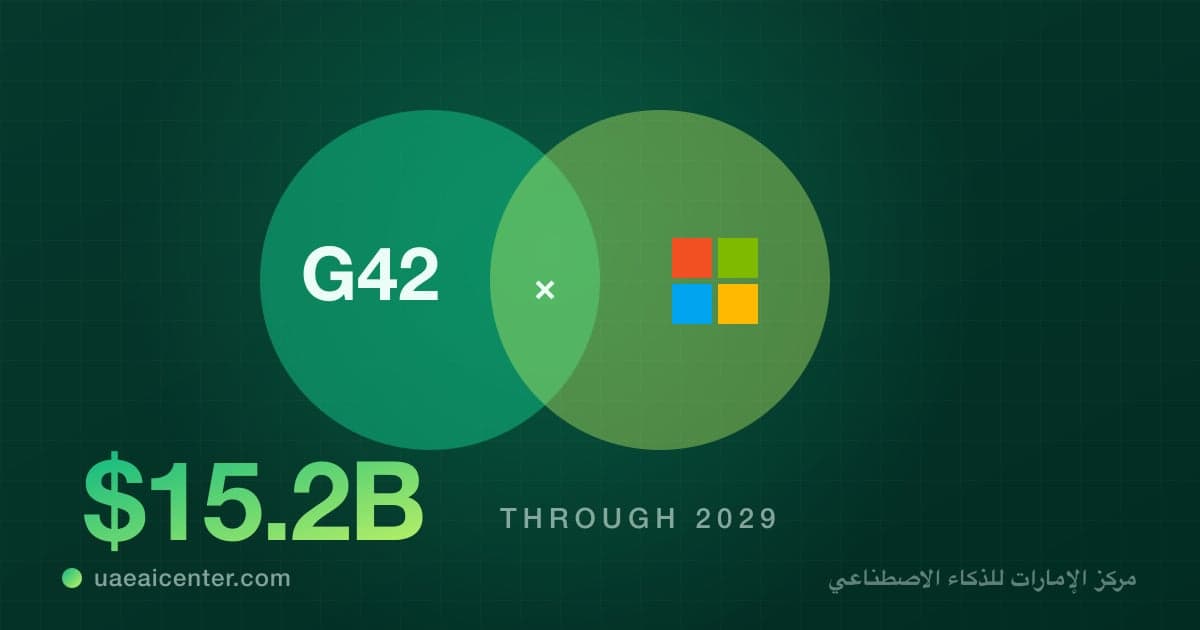
Microsoft announced a $1.5 billion strategic equity investment in G42 in April 2024, taking a minority stake, with Vice Chair and President Brad Smith joining G42's board, per Microsoft's announcement. In November 2025, Microsoft disclosed a total UAE investment of $15.2 billion for 2023 through 2029.
Here is where a surprising amount of coverage goes wrong, and where this article earns its keep. The two figures are not additive. The $15.2 billion is not new money stacked on top of the $1.5 billion stake; it contains it. Microsoft's own breakdown, published by Brad Smith on the Microsoft On the Issues blog in November 2025, counts the G42 equity as one line item inside the cumulative total. Anyone quoting "$16.7 billion" has double-counted.
The disclosed breakdown looks like this:
| Component | Period | Amount |
|---|---|---|
| G42 equity stake (announced April 2024) | Spent, 2023-2025 window | $1.5B |
| Datacenter capital expenditure | Spent, 2023-2025 | $4.6B+ |
| Operating expenses | Spent, 2023-2025 | $1.2B+ |
| Subtotal, already spent | 2023-2025 | approx. $7.3B |
| Planned datacenter capital expenditure | 2026-2029 | $5.5B+ |
| Planned operating expenses | 2026-2029 | approx. $2.4B |
| Subtotal, planned | 2026-2029 | $7.9B+ |
| Total | 2023-2029 | $15.2B |
Source: Microsoft On the Issues, November 3, 2025.
Read the table like an investor reading a term sheet, and two things stand out. First, roughly $7.3 billion was already deployed by the time the number was announced, so this is a progress report as much as a pledge. Second, the equity stake is the smallest major component. The real money is concrete, cooling, and chips: over $10 billion in datacenter capex across the full period.
The April 2024 deal also included Microsoft support for a $1 billion fund for developers, aimed at building AI skills in the UAE and the wider region, according to the same Microsoft announcement.
What Did the US Get in Return?
Washington extracted three things: a first-of-its-kind Intergovernmental Assurance Agreement between the US and UAE governments on AI safety and security, G42's divestment of its Chinese holdings in February 2024, and a commitment to phase out Chinese hardware such as Huawei equipment, the latter two according to CNBC reporting on the deal.
The assurance agreement is the piece with no real precedent. Rather than trusting a private contract between Microsoft and G42, the two governments signed their own agreement governing how American AI technology would be secured, per Microsoft's April 2024 announcement. Think of it as a chip-custody arrangement written at the treaty level rather than the vendor level.
G42's China divestment was the visible cost. The group sold down its Chinese positions, including a reported stake in ByteDance, and agreed to strip Chinese equipment out of its infrastructure, per CNBC. For a company that had previously kept a foot in both technology ecosystems, this was a definitive choice of sides. In our reading, that choice, more than any dollar figure, is what made everything that followed possible.
The bilateral machinery has since expanded well beyond one company. The US-UAE AI Acceleration Partnership, signed in May 2025, created a government-to-government framework for AI cooperation with shared protection standards, and its first interagency working group met in April 2026, per the US State Department. Within that framework, the UAE also reaffirmed plans to invest $1.4 trillion in the US over ten years. The G42-Microsoft deal was the prototype; the 2025 partnership turned its assurances into standing national policy.
What Do Microsoft's Export Licenses Cover?
Microsoft holds US export licenses for the equivalent of roughly 81,900 NVIDIA A100 GPUs destined for the UAE, according to its November 2025 disclosure. The total arrived in two tranches: 21,500 A100 equivalents approved under the Biden administration, and 60,400 more, shipped as newer GB300 systems, approved in September 2025.
Export licenses function like visas for silicon: every advanced chip needs Washington's stamp before it boards the plane. Measuring in "A100 equivalents" simply normalizes different chip generations against a common baseline, since a single GB300-class system delivers far more compute than the 2020-era A100 it is benchmarked against.
The two-tranche history is worth pausing on. The Biden-era approval of 21,500 equivalents was cautious, granted while the assurance agreement was still fresh. The September 2025 tranche was nearly three times larger and covered current-generation hardware. Whatever else changed between administrations, the direction of travel for licensed UAE compute went one way: up.
Could that pattern hold? We would not treat it as guaranteed. Licenses are policy instruments, and policy moved once already between 2024 and 2025. What the numbers do establish, as of the November 2025 disclosure, is that the UAE holds one of the largest licensed allocations of American AI compute anywhere outside the US, with Microsoft as the named custodian. The same license machinery underpins the separate, larger buildout we cover in our Stargate UAE explainer.
What Does Each Side Gain?
Microsoft gains a Gulf beachhead in the market where AI adoption runs hottest: the UAE leads Microsoft's own global AI Diffusion leaderboard, with 70.1% of the working-age population using AI in Q1 2026 against a global rate of 17.8%, per the Microsoft AI Economy Institute. The UAE gains licensed compute and American political legitimacy.
For Microsoft, the commercial logic is straightforward. PwC projects AI will contribute $96 billion to the UAE economy by 2030, about 13.6% of GDP, the largest relative impact in the Middle East. A CTO in Dubai comparing cloud regions today finds Microsoft embedded in the sovereign cloud layer through Core42, holding board-level visibility into G42, and operating with government blessing on both sides of the relationship. No competitor enjoys an equivalent position.
For the UAE, the prize is harder to price but arguably larger. Money was never the constraint; Abu Dhabi's own vehicles, profiled in our look at MGX and the UAE's AI investment machine, command capital at a scale few sovereign funds match. What the UAE could not buy on the open market was legal access to frontier American chips and a formal US signal that Abu Dhabi is a trusted AI partner. The Microsoft deal delivered both.
Each side traded the thing it had in surplus for the thing it could not manufacture: Microsoft supplied trust and technology, the UAE supplied capital, energy, and speed. That symmetry, in our view, is why the partnership has widened rather than frayed since 2024, growing from a single equity stake into a $15.2 billion multi-year program.
The Risks: Dependency That Runs Both Ways
The honest assessment is that both partners took on concentrated geopolitical exposure. The UAE's licensed compute, all 81,900 A100 equivalents of it as of November 2025, exists at the discretion of US export policy, which shifted once between the Biden and Trump tranches and could shift again. Microsoft, meanwhile, has tied over $15 billion to a single foreign partner.
For Abu Dhabi, the dependency is structural. Chips, licenses, and the assurance framework all route through Washington. A future US administration that tightened export policy would not need to renegotiate anything; it could simply slow the license queue. The UAE has hedged by keeping its partner bench deep, working with OpenAI, Oracle, NVIDIA, SoftBank Group, and Cisco on Stargate UAE, but every one of those partners answers to the same export regime.
Microsoft's exposure is subtler. Its UAE program is anchored to a conglomerate chaired by the national security adviser of a foreign state, in a region where alignments can move quickly. The company has effectively made itself the guarantor of G42's conduct before US regulators; the assurance agreement formalizes that role. If G42's compliance ever slipped, Microsoft's name would be on the paperwork.
There is also a quieter commercial risk on both sides. The 2026-2029 tranche, $7.9 billion or more, is planned rather than spent. Plans stated in a November 2025 blog post are commitments of intent, not escrowed funds. We would expect them to materialize given the trajectory so far, but readers should treat spent and planned figures as different grades of certainty, exactly as the table above separates them.
Frequently Asked Questions
Is the $15.2 billion separate from Microsoft's $1.5 billion investment in G42?
No. The $15.2 billion, announced in November 2025, is Microsoft's cumulative UAE investment for 2023 through 2029, and it includes the $1.5 billion G42 equity stake announced in April 2024. The figures are not additive. Roughly $7.3 billion of the total was already spent by 2025, with $7.9 billion or more planned through 2029.
Who owns and runs G42?
G42 is an Abu Dhabi based AI holding group chaired by Sheikh Tahnoon bin Zayed Al Nahyan, the UAE's national security adviser, with Peng Xiao as Group CEO. Its operating companies include Core42 (sovereign cloud), Inception (AI models), Presight (publicly listed analytics), Khazna Data Centers, M42 (health), Space42, AIQ (an ADNOC joint venture), and CPX (cybersecurity).
What is the Intergovernmental Assurance Agreement?
It is a first-of-its-kind agreement between the US and UAE governments, attached to the April 2024 Microsoft-G42 deal, covering commitments on AI safety and security. Instead of relying solely on a commercial contract, the two governments themselves set the terms for how American AI technology deployed through G42 is protected and governed.
How many GPUs can Microsoft ship to the UAE?
Microsoft disclosed in November 2025 that it holds US export licenses for the equivalent of roughly 81,900 NVIDIA A100 GPUs. The approvals came in two tranches: 21,500 A100 equivalents under the Biden administration, then 60,400 more, delivered as newer GB300 systems, approved in September 2025 under the Trump administration.
Why did G42 cut its ties with China?
Under US pressure, G42 divested its Chinese holdings in February 2024, including a reported ByteDance stake, and committed under the Microsoft deal to phasing out Chinese hardware such as Huawei equipment, according to CNBC reporting. Access to controlled American chips required an unambiguous exit from the Chinese technology ecosystem, and G42 chose the American side.
How does the partnership relate to Stargate UAE?
They are distinct projects sharing a builder. Stargate UAE, announced in May 2025, is a 1-gigawatt cluster developed by G42 with OpenAI, Oracle, NVIDIA, SoftBank Group, and Cisco inside Abu Dhabi's 5-gigawatt UAE-US AI Campus. Microsoft is not a Stargate partner, but both efforts depend on the same US export-license framework and bilateral assurances.
Keep Reading
The G42-Microsoft alliance is one pillar of a much larger national project. For the full picture, start with our complete guide to AI in the UAE, then follow the infrastructure story through Stargate UAE and the data-center buildout, the capital story through MGX and the UAE's AI investment vehicles, and the research story through TII's Falcon models. New briefings land regularly; subscribe via our contact page to get them first.
Stay ahead of AI in the Emirates
Independent, sourced analysis of UAE AI strategy, infrastructure, and policy — no hype, no government affiliation. Get new briefings as they publish.
Ayyoub Bouazza is the editor of UAE AI Center, an independent publication covering artificial intelligence in the Emirates. Every figure in this article is attributed inline to a named primary source; the publication is not affiliated with the UAE government or any official body.