

UAE AI Strategy 2031, Explained: Targets and Progress
On this page +
What Is the UAE AI Strategy 2031?
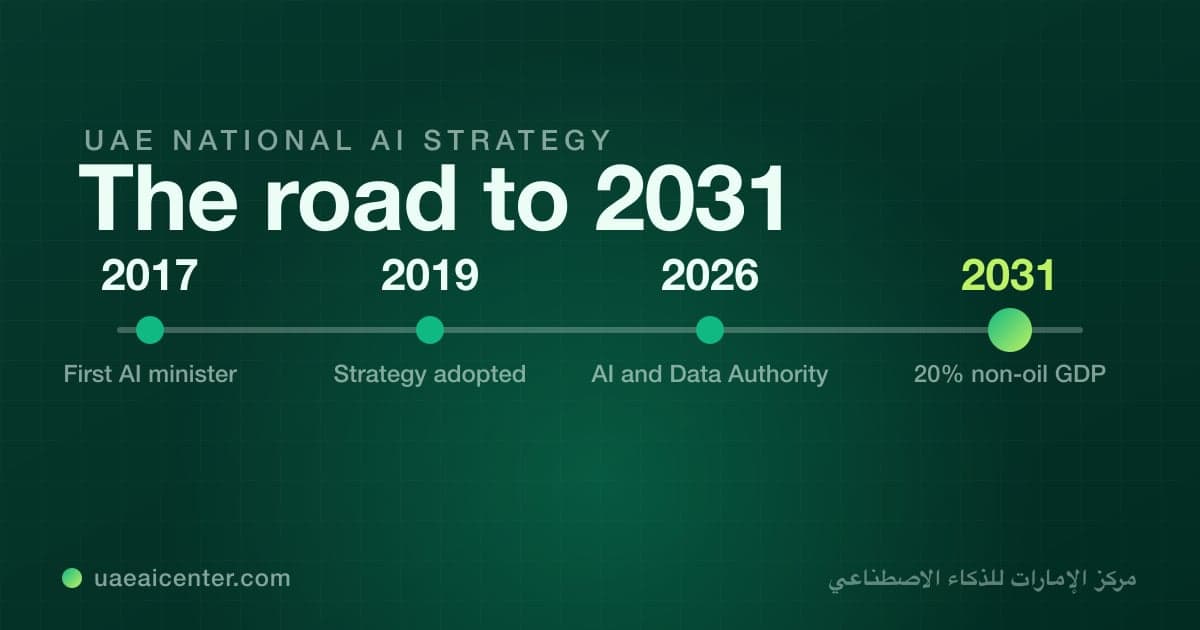
The UAE AI Strategy 2031 is the country's national plan to make artificial intelligence a core driver of government services and the economy by 2031. It began as the world's first national AI strategy, launched in October 2017 according to OECD.AI, and was formally adopted by the UAE Cabinet in 2019.
Key Takeaways
- The UAE launched the world's first national AI strategy in October 2017 and appointed the world's first dedicated AI minister the same month, per OECD.AI.
- The UAE Cabinet formally adopted the National AI Strategy 2031 in 2019, with oversight assigned to the AI Minister.
- PwC Middle East projects AI will contribute about US$96 billion to UAE GDP by 2030, roughly 13.6% of GDP and the highest share in the Middle East.
- Officials have voiced an ambition for AI to reach 20% of non-oil GDP by 2031; that figure is an announced target, not a legal requirement.
- On 14 June 2026, the UAE approved a federal Artificial Intelligence and Data Authority that consolidates the AI Office and the UAE Data Office under one roof.
The story starts in October 2017, when the UAE published its national Strategy for Artificial Intelligence and, in the same month, appointed Omar Sultan Al Olama as Minister of State for Artificial Intelligence. No other country had a dedicated AI minister at the time. His portfolio later expanded to cover AI, Digital Economy and Remote Work Applications, and he remains the central figure in UAE AI policy today.
That 2017 document was then developed into the National AI Strategy 2031, which the UAE Cabinet formally adopted in 2019, placing oversight with the AI Minister. The full strategy text is published on the UAE AI Office site.
One point of rigor matters before going further, and it's the reason this explainer exists. Coverage of UAE AI policy routinely blurs three very different things: binding law, non-binding guidance, and announced plans. The Strategy 2031 itself is a policy framework, not a statute, and nothing in it creates legal obligations for private companies. Throughout this article, we'll label each instrument as LAW, GUIDANCE, or ANNOUNCED PLAN so you can tell what actually binds you. For the wider context of how the strategy fits into the country's overall AI push, see our complete guide to AI in the UAE.
Why does that distinction matter so much here? Because the UAE moves fast and announces often. A reader who treats every headline as law will over-comply; one who treats everything as marketing will miss real obligations like data protection rules.
What Are the Eight Objectives of the Strategy?
The National AI Strategy 2031 sets eight objectives, according to OECD.AI's policy dashboard: AI reputation, sector competitiveness, a fertile ecosystem, AI in government services, talent, research-to-industry transfer, data and test-bed infrastructure, and governance. Together they cover the full pipeline from global branding through skills to regulation.
Here is each objective with a short gloss:
- Build a reputation as an AI destination. Position the UAE as a place where AI companies, researchers and capital want to be.
- Increase competitiveness in priority sectors. Apply AI where the UAE already competes, rather than spreading effort thinly.
- Develop a fertile ecosystem. Support startups, investment vehicles and partnerships that let AI businesses form and scale.
- Adopt AI across government services. Use customer-facing government services as the proving ground for deployment.
- Attract and train AI talent. Build the workforce through education and recruitment; we cover the education side in detail in how the UAE teaches AI.
- Bring world-leading research to industry. Move research output into commercial application instead of leaving it in papers.
- Provide data and test-bed infrastructure. Give developers the datasets and controlled environments needed to build and trial systems.
- Ensure strong governance and effective regulation. Develop the rules and oversight structures that make the other seven sustainable.
Notice the sequencing logic. Objectives one through three are about attraction, four through six about capability, and seven and eight about foundations. The eighth objective, governance, is the one that has evolved most visibly since 2019, as the sections below on the new federal authority and Regulatory Intelligence show.
None of these objectives carries a statutory mechanism on its own. They're direction-setting commitments (ANNOUNCED PLAN territory) that other instruments, from the UAE Personal Data Protection Law (PDPL) to free-zone rules, then implement in binding form.
The Economic Targets: What the Numbers Actually Say
Two headline numbers dominate discussion of the strategy's economics. PwC Middle East projects AI will contribute roughly US$96 billion to UAE GDP by 2030, about 13.6% of GDP and the highest share in the Middle East. Separately, UAE officials target AI contributing 20% of non-oil GDP by 2031, according to reporting by Gulf News.
These two figures are often mashed together in coverage, so it's worth pulling them apart.
The PwC estimate is an independent projection, not a government target. It comes from the firm's regional study on AI's economic potential, and the precise share is 13.6%, a figure sometimes rounded up inaccurately in secondary coverage. It models what AI adoption could plausibly add to the economy by 2030 under the trajectories PwC assessed.
The 20% non-oil GDP figure is different in kind. It's an ambition voiced by UAE officials, an ANNOUNCED PLAN in our labeling, not a statutory requirement or an independently modeled forecast. Treat the US$96 billion as an analyst's projection and the 20% as a political ambition; neither is a guarantee, and only one comes from an independent source.
Does the distinction change anything practical? For an investor reading a pitch deck that cites "government-mandated 20% AI GDP," yes. There is no mandate. What exists is a consistent policy direction backed by real institutional spending and, as of June 2026, a consolidated federal authority to drive it. That direction is genuinely strong evidence of intent. It just isn't the same thing as a legal commitment with enforcement teeth, and diligence documents should say so.
Who Runs UAE AI Policy Now?
As of June 2026, UAE AI policy is being consolidated under a new federal Artificial Intelligence and Data Authority, approved by Sheikh Mohammed bin Rashid on 14 June 2026 and chaired by AI Minister Omar Sultan Al Olama, according to the Dubai Media Office. This is the biggest structural change since the strategy launched.
To see why it matters, look at what came before. Since February 2018, the UAE Council for Artificial Intelligence and Blockchain, also chaired by Al Olama, has coordinated cross-sector AI adoption and advised on ethics and governance. As law firm Latham & Watkins notes, the Council is an institutional coordination body, not a legislature. Alongside it sat the AI Office, the UAE Data Office created under Federal Decree-Law No. 44 of 2021, and TDRA's digital government sector, each holding a piece of the puzzle.
The June 2026 decision folds three of those pieces together. The new authority absorbs the AI Office, TDRA's digital government sector, and the UAE Data Office, and reports directly to Cabinet. Notably, the UAE Data Office had never become fully operational, which left parts of the data regime, including the still-unissued PDPL executive regulations, without an active institutional driver. As of June 2026, those executive regulations under the UAE Personal Data Protection Law (PDPL, a LAW in force since January 2022) remain unissued.
For the first time, UAE AI and data policy has a single federal home with Cabinet-level reporting lines, which is precisely the setup you'd build if you intended to start operationalizing rules rather than just announcing them. In our reading, that makes the authority the single most important thing to watch in UAE AI governance right now.
Rounding out the picture is the UAE Charter for the Development and Use of AI, published in June 2024 with 12 ethical principles. The Charter is explicitly non-binding: GUIDANCE, not law. How the new authority builds on all of this compared with Europe's approach is a story of its own, covered in our comparison of UAE AI regulation and the EU AI Act.
What Is Regulatory Intelligence?
Regulatory Intelligence is the UAE's plan, announced on 14 April 2025 by the UAE Cabinet General Secretariat, to use AI to help draft and revise laws, described by the government as a global first. Officials project up to 70% faster legislative cycles, with humans retaining final approval authority. It is an ANNOUNCED PLAN, not an enacted process.
The announcement drew worldwide headlines, many of them overcooked. So what was actually announced? A new Cabinet-level Regulatory Intelligence Office will oversee an ecosystem in which AI systems analyze existing legislation, court judgments and government data, then propose drafts and amendments for human lawmakers to review and approve.
Three caveats keep the claim honest. First, the 70% figure is an official projection of what the system could achieve, not a measured result; we attribute it because no independent verification exists yet. Second, the initiative had not been reported as fully deployed at the time of writing (June 2026), so its practical impact remains untested. Third, approval authority stays with humans, meaning the constitutional process of lawmaking doesn't change; what changes is the drafting workshop behind it.
Is this connected to the Strategy 2031? Directly. Objective eight calls for strong governance and effective regulation, and Regulatory Intelligence is the most ambitious expression of that objective so far. A government that builds AI into its own legislative plumbing is signaling that the strategy applies to the state itself, not just to the private sector it hopes to attract.
For businesses, the near-term takeaway is modest: watch for faster regulatory revision cycles in the UAE over the coming years, and don't assume today's rulebook is static.
What Should Businesses Take From the Strategy?
The practical message for businesses is to separate what binds you from what signals direction. As of mid-2026, the UAE has no single comprehensive federal AI statute equivalent to the EU AI Act, per Latham & Watkins and Bird & Bird's regulatory tracker. Instead, a layered framework of laws, guidance and plans applies.
Think of it like an architect's masterplan versus a building code. The Strategy 2031 is the masterplan: it tells you what skyline the client wants by 2031. The PDPL and free-zone data rules are the building code: they tell you what you must actually do, inspected and enforceable. Confusing the two leads either to over-engineering or to failed inspections.
Here's the instrument-by-instrument breakdown:
| Instrument | Status | What it means for you |
|---|---|---|
| National AI Strategy 2031 (2017, adopted 2019) | Policy framework (ANNOUNCED PLAN) | Direction and priorities; no direct obligations |
| PDPL, Federal Decree-Law No. 45 of 2021 | LAW (in force since January 2022) | Binding data protection duties; executive regulations still unissued as of June 2026 |
| UAE AI Charter (June 2024) | GUIDANCE (explicitly non-binding) | 12 ethical principles; useful benchmark, no penalties |
| Regulatory Intelligence (April 2025) | ANNOUNCED PLAN | AI-assisted lawmaking; expect faster rule changes over time |
| AI and Data Authority (June 2026) | Institutional body (established) | New single regulator-in-waiting for AI and data files |
A quick micro-scenario shows the framework in action. Picture a compliance lead at a fintech weighing a Dubai expansion. Her binding checklist is short: PDPL compliance, plus DIFC or ADGM data rules if she picks a financial free zone. Her strategic checklist is longer: alignment with the Charter's principles, and certification programs like the Dubai AI Seal, which we unpack in our guide to Dubai's AI Seal and licensing. The Seal is voluntary certification, yet it's required for partnering on government AI projects, a classic example of GUIDANCE with commercial teeth.
The UAE regulates AI with a light statutory touch and a heavy institutional presence, so the smart posture is to comply with the law that exists and align with the direction that's coming. We've found that companies treating the Charter and Seal as early drafts of future expectations adapt faster when guidance hardens.
Frequently Asked Questions
When did the UAE launch its AI strategy?
The UAE launched its national Strategy for Artificial Intelligence in October 2017, the first initiative of its kind worldwide according to OECD.AI. The same month, it appointed Omar Sultan Al Olama as the world's first dedicated AI minister. The UAE Cabinet formally adopted the developed National AI Strategy 2031 in 2019, placing oversight with the AI Minister.
Is the UAE AI Strategy 2031 a law?
No. The strategy is a national policy framework, not legislation. Binding obligations come from separate instruments, chiefly the UAE Personal Data Protection Law (Federal Decree-Law No. 45 of 2021). Other pieces, like the June 2024 AI Charter, are explicitly non-binding guidance, while initiatives such as Regulatory Intelligence remain announced plans rather than enacted rules.
How much will AI contribute to UAE GDP?
PwC Middle East projects AI will contribute roughly US$96 billion to UAE GDP by 2030, about 13.6% of GDP and the highest share in the Middle East. Separately, UAE officials have voiced an ambition for AI to contribute 20% of non-oil GDP by 2031, according to reporting by Gulf News. The 20% figure is a target, not a statute.
Who is the UAE Minister for Artificial Intelligence?
Omar Sultan Al Olama, appointed Minister of State for Artificial Intelligence in October 2017, which made him the world's first dedicated AI minister. His portfolio later expanded to cover AI, Digital Economy and Remote Work Applications. As of June 2026, he also chairs the newly approved federal Artificial Intelligence and Data Authority, which reports to the UAE Cabinet.
What is the new UAE Artificial Intelligence and Data Authority?
On 14 June 2026, Sheikh Mohammed bin Rashid approved establishing a federal Artificial Intelligence and Data Authority, chaired by Al Olama. It consolidates the AI Office, TDRA's digital government sector, and the UAE Data Office into a single body reporting to Cabinet, giving UAE AI and data policy one institutional home for the first time.
What is the UAE's Regulatory Intelligence initiative?
Announced on 14 April 2025, Regulatory Intelligence is a UAE Cabinet plan to use AI to help draft and revise laws, described by the government as a global first. Officials project up to 70% faster legislative cycles, overseen by a new Cabinet Regulatory Intelligence Office, with humans retaining final approval authority. As of June 2026, it remains an announced plan rather than an enacted process.
Keep Reading
The Strategy 2031 is one thread in a much larger story. Start with our complete guide to AI in the UAE for the full picture, then compare enforcement philosophies in UAE AI regulation vs the EU AI Act. If you're building here, the guides to Dubai's AI Seal and how the UAE teaches AI cover certification and talent. For new briefings as UAE AI policy evolves, subscribe via our contact page.
Stay ahead of AI in the Emirates
Independent, sourced analysis of UAE AI strategy, infrastructure, and policy — no hype, no government affiliation. Get new briefings as they publish.
Ayyoub Bouazza is the editor of UAE AI Center, an independent publication covering artificial intelligence in the Emirates. Every figure in this article is attributed inline to a named primary source; the publication is not affiliated with the UAE government or any official body.